![logo_moinai-full-transparent-1.png]](https://helpcenter.moin.ai/hs-fs/hubfs/logo_moinai-full-transparent-1.png?height=40&name=logo_moinai-full-transparent-1.png)
The Statistics function in the menu item of the same name enables a detailed evaluation of all interactions between users and the AI chatbot. By analysing performance values such as automation rate, conversions and user ratings, the effectiveness of the digital assistant can be measured objectively. With this data basis, the user experience can be improved and optimisation potential in the content can be identified.
1. Statistics
The statistics section visualises the most important performance indicators. This data allows you to quickly assess how successfully enqueries are being automated or targets achieved. All conversations that have taken place through editorial topics and agents are included.
The statistics provide an overview of the following key figures:
- Conversations
- Automation
- Positive and negative ratings
- Conversions
- Human Takeovers
- Top Intents
Filter period, channel and ratings
The data view can be adjusted using the controls at the top of the hub:
-
The desired interval is set using the drop-down menu for the period. By default, the results for the last 28 days are displayed. If only 1 or 2 days are selected, the statistics show the hourly progression.
-
The channel drop-down menu can be used to evaluate either all channels together or a specific channel.
View without channels:

View with channels:

-
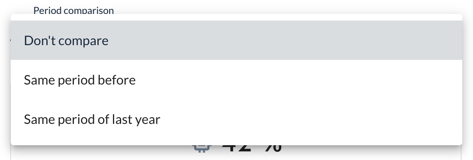
It is also possible to compare time periods. To do this, select from the drop-down menu which period should be compared or whether no comparison should take place:
2. Focus Reports
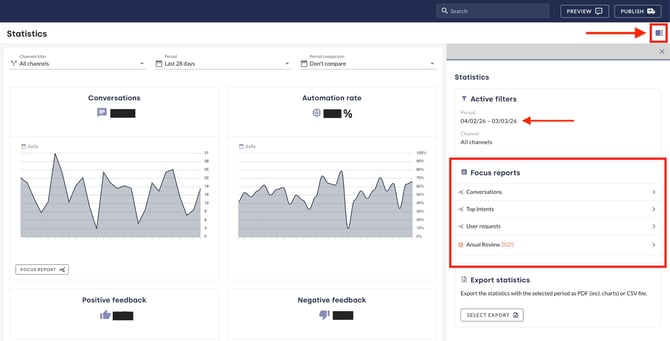
Detailed insights into specific behaviour patterns and content performance are generated via the focus reports. Clicking on the sidebar icon  in the top right-hand corner opens the selection mask on the right-hand side. Here, the following focus reports can be displayed for the previously selected period for the following categories: Conversations, Top Intents, User Requests and Annual Review.
2.1 Focus Report: Conversations
This report displays the number of conversations for the selected period in a diagram.
It also shows the average duration per conversation (from the first to the last message of the conversation), the number of intents per conversation and the average distribution of conversations by day of the week and time of day. When displaying the distribution of conversations, you can choose whether to show the data for all topics or only for a specific intent.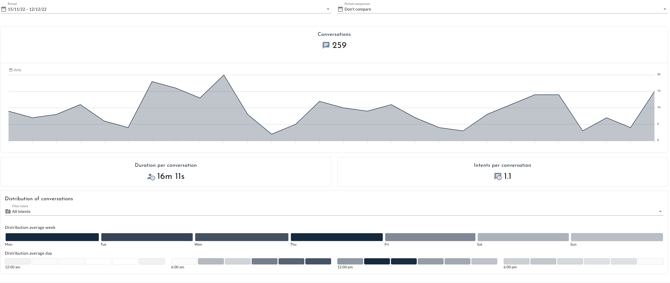
2.2 Focus Report: Top Intents
This report enables a detailed analysis of the frequency with which editorial topics and agents are accessed within the selected time period. It also provides an overview of the editorial topics and agents with the greatest impact and particular potential for optimisation. In addition, AI-generated suggestions for new content are listed in order of relevance.
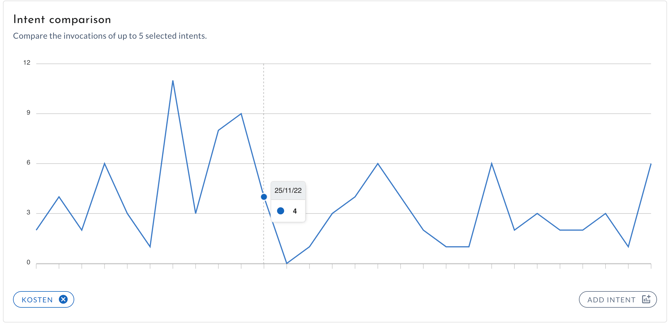
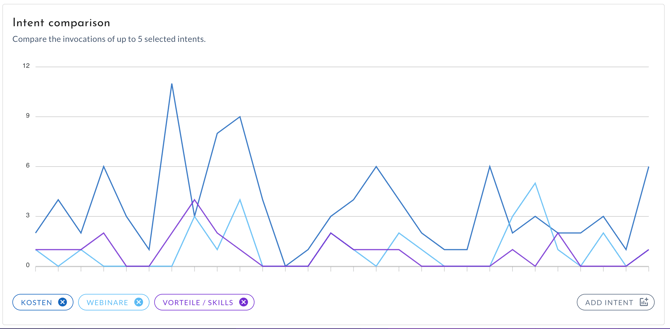
- Comparison on Intents: The intent requests are visualised within a diagram. For comparative evaluation, up to five topics can be added simultaneously using the Add intent button.
Depiction of 1 intent:
Depiction of several intents (exemplary 2):
- Biggest Intent: The intents that provide the greatest added value for users are listed here, measured by the number of views, positive ratings and conversion goals achieved.
- Biggest potential: The intents that offer the greatest potential for optimisation are listed here because they are accessed particularly frequently and receive a relatively high number of negative user ratings.
By default, the top 5 intents are displayed. Below, you can set how many intents should be displayed per page. The arrow buttons can be used to switch between the pages.
2.3 Focus report: User Requests
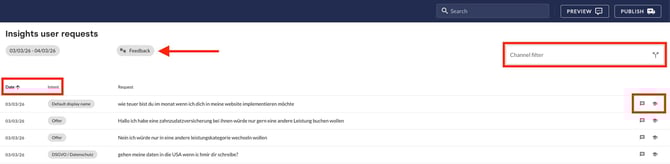
This report takes you to the User Insights section. This is where all user enquiries on existing topics and ratings are displayed. For precise analysis, User Insights can be filtered by channel and feedback rating. You can sort the overview individually by intent or date by clicking on the respective column headings.
At the end of each row, there are function icons for detailed evaluation:
-
Speech bubble icon: Clicking on this icon opens the complete chat history of the conversation.
-
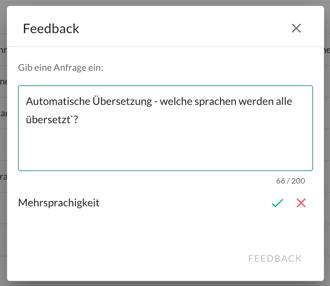
Hat icon: This icon displays the specific user question that was answered by the AI chatbot and subsequently received a positive/negative rating. The AI agent used to generate the response is also displayed.
How user insights contribute to improving response content is described in this article.
2.4 Focus Report: Annual Review
This report summarises the key figures of the year. In addition, the top month, the top day of the week and the top time are presented.
3. Data export
An export function is available for external reports or in-depth analyses in spreadsheet programmes.
-
Click on the sidebar icon
in the top right-hand corner to topen the selection screen on the right-hand side. -
Then, under Export statistics, select the Select export button to open the screen with the available exports.
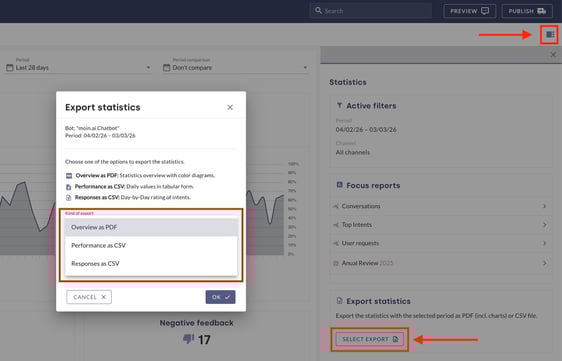
- All key figures for a period in the overview can be exported as a PDF or CSV file. The following options are available:
- Overview as PDF: Statistical overview with colour diagrams.
- Performance as CSV: Daily values in table form.
- Responses as CSV: Daily evaluation of topics.
- Once the type of export has been selected, the file can be downloaded using the DOWNLOAD
 button.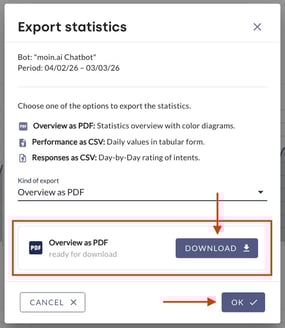
- Click OK to complete the export.
Interactions of website visitors with the AI chatbot can additionally be transferred to analysis tools. This article describes how tracking can be set up.