![logo_moinai-full-transparent-1.png]](https://helpcenter.moin.ai/hs-fs/hubfs/logo_moinai-full-transparent-1.png?height=40&name=logo_moinai-full-transparent-1.png)
Automated product advice enables users to be guided through a range of products or services in a targeted manner. In the moinAI chatbot, advice is provided via structured pre-qualification followed by smart recommendations. This process increases the conversion rate by completing imprecise enquiries with targeted options before the AI agent makes a final recommendation.
1. Pre-qualification
During a consultation, incomplete requirements often need to be filled in. In order to be able to make a qualitative recommendation, an upstream data collection process is therefore used. Users enter their preferences (e.g. flavour, budget or area of application) via a form. Only once all the necessary information is available does a specialised AI agent take over the evaluation and respond to the enquiry. The solution uses LLM functionalities to reliably recognise even imprecise formulations or similar concepts (e.g. ‘strawberry’ as ‘fruit flavour’).
The use of forms is the most efficient method for flexibly pre-qualifying enquiries and thus providing users with structured advice.
-
Structure: Multiple-choice questions are suitable for a targeted needs analysis, while free text fields allow for flexible input.
Note: Multiple-choice trees should not be nested too deeply in order to maintain clarity for administrators and users. -
Targeted: The conversation remains linear and clear.
-
Handover: Upon completion, the entire conversation context is handed over to an AI agent, which processes the data using an AI action.
The creation of forms is described in this article.
To ensure that the conversation follows a fixed script, the input bar can be locked during data recording. However, as this restricts natural conversation, this option should only be used deliberately. This article describes how to lock the input bar.
2. Technical connection and data processing
In order for the AI agent to make recommendations based on pre-qualification, it needs access to a data source. If the source is located in the knowledge base, a CSV AI action is suitable. If the source is an external database, access is provided via a webhook.
The data basis and the precise design of the AI action instructions are crucial for the success of the consultation:
-
Structured data basis: The database is uploaded to the AI chatbot's knowledge base as a structured CSV file with descriptive column titles. This article describes what to consider when using a CSV file. A clean structure is also a prerequisite for successful connection to a product database.
-
Pre- and post-prompts: Instructions must define how the data is processed before and after execution.
-
Formatting: Requirements for the output of results, e.g. as bullet points or using slides with images.
-
Technical terms: The use of terms such as ‘user query’ in the instructions for user input and the use of database column titles helps the AI to assign data correctly.
Detailed instructions for setting up the CSV AI action can be found in this article.
As an alternative to CSV files, the connection is made directly to an external product database or integrations (e.g. Shopify) using webhooks. This enables dynamic updating of product ranges or availability in real time, without manual uploads. The use of webhooks is described in this article.
Result control
For optimal readability in chat format, it is recommended to limit the output to a maximum of ten results. It is not possible to guarantee that all results will be displayed without exception or that identical results will always be displayed, as the AI agent re-evaluates each recommendation and the LLM functionality introduces variance. Alternatively, completely editorial content can be created for this type of functionality.
The quality of the recommendation depends directly on the accuracy and completeness of the data records.
3. Application examples
|
Industry |
Application |
Description |
|
E-commerce |
Skin type consultation |
Dermatological characteristics and goals (e.g. skin type, making pores appear larger) are mapped to care products in order to generate exact matches from an extensive catalogue. |
|
Insurance |
Tariff pre-qualification |
By querying living conditions and risk coverage, a precise pre-qualification for complex tariff structures is carried out. |
|
Education |
Training & study orientation |
Qualitative analysis of interests and qualifications to identify suitable apprenticeships, degree programmes or further training opportunities. |
|
Real estate |
Property finder |
Queries about budget, number of rooms and location filter suitable properties from a CSV list. |
|
Software/SaaS |
Package configurator |
Determination of the required functions and number of users to recommend the appropriate tariff. |
Application example: Automated product advice (tea advisor)
The tea advisor is a good example of how structured, AI-supported product advice works. The aim is to translate general user requests into precise product recommendations based on a comprehensive database stored in the knowledge base.
The advice process (procedure)
-
Start/trigger: The advice is started specifically via an action button (e.g. in the teaser or in the welcome message) in order to actively guide users into the advice process.
-
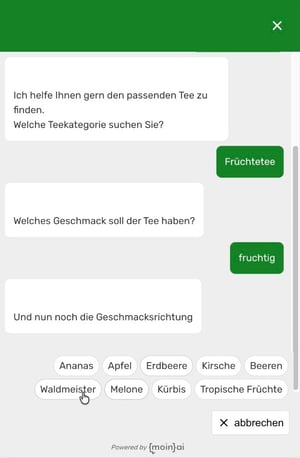
Structured pre-qualification: A form guides users through a targeted series of questions with multiple-choice options. This determines preferences such as tea category (e.g. fruit tea, black tea), specific flavour profiles (e.g. ‘fruity’ or ‘citrus note’) and specific flavours (e.g. woodruff, melona).
-
Context transfer: Once the query is complete, the entire conversation history is transferred to a specialised AI agent as collected context.
-
Data comparison via AI action: The AI agent uses a CSV AI action to search the stored product database (CSV file with over 300 items) for matches.
-
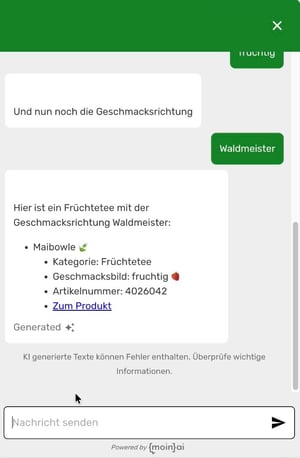
Generated recommendation: Based on the facts returned, the AI agent creates a personalised response that outputs tailor-made products including details such as brewing time, item number and a direct link to the product page.
CSV AI action for tea consultation
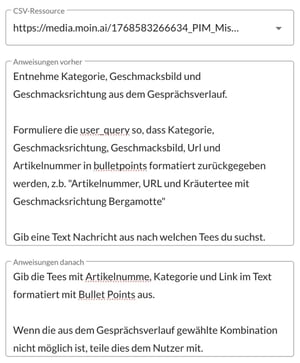
For precise product identification, specific instructions for processing database fields (e.g. item name, flavour, organic status) are stored in the CSV AI action.
Instructions beforehand (analysis): "Take the category, flavour profile and flavour from the previous conversation. Formulate the user_query so that the database is searched specifically for these characteristics."
Instructions afterwards (output): ‘Output the matching teas with item number, category and link. Format the answer in bullet points. If the desired combination is not available, kindly inform the user.’